Solemnity of Christ the King, Year A
Matthew 25:31-46
Fr. Jijo Kandamkulathy CMF
Claretian Missionaries
We imagine the judgment as a courtroom. A throne. A king. A line of souls waiting to hear their verdict. And we assume the questions will be about belief. Did you profess the right creed? Did you belong to the right church? Did you say the right prayers? Did you keep the right rules? We imagine a religion of correct opinions. A faith of the head. And we imagine that God will grade us on our accuracy.
But the Gospel today shatters every one of these assumptions. The king does not ask about creeds. He does not ask about rituals. He does not ask about the frequency of our prayers or the precision of our theology. He asks one thing. Did you feed me when I was hungry? Did you give me drink when I was thirsty? Did you welcome me when I was a stranger? Did you clothe me when I was naked? Did you visit me when I was sick? Did you come to me when I was in prison?
The entire judgment rests on the works of mercy. Not on what we believed. But on what we did. Not on what we said. But on how we lived. This is not a contradiction of faith. It is the revelation of what faith is meant to produce. Because faith that does not become action is not faith at all. It is sentiment. It is an opinion. It is a warm feeling that never leaves the room. Faith that becomes conviction becomes value. And value becomes action. And action is the only evidence of faith that lasts.
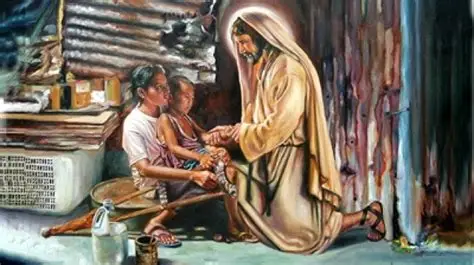
This is what the Church celebrates on the Solemnity of Christ the King. We do not crown a ruler who demands homage. We crown a king who identifies himself with the poorest of the poor. We crown a king whose throne is not a palace but a hospital bed. Whose crown is not gold but thorns. Whose reign is not over territory but over hearts. And whose presence is not in the temple but in the streets.
The king is in the streets. That is the scandal of this feast. The Gospel does not say that the king will come to the temple and ask us about our devotions. It says the king will come in the guise of the hungry, the thirsty, the stranger, the naked, the sick, the imprisoned. And he will ask us not what we believed but what we did. The Gospel worked in the streets. Not in the sanctuary. The faith became flesh in the alleyways and the hospices and the prisons. And the question is whether our faith has ever left the sanctuary at all.
The works of mercy are not optional extras. They are not add-ons to the Christian life. They are the Christian life. They are the concrete form of love. They are the way faith becomes visible. They are the way conviction becomes value. They are the way the interior life of prayer and the exterior life of action become one. The person who prays and does not feed the hungry has not understood the Gospel. The person who feeds the hungry without prayer will run empty. But the person who prays and feeds, who worships and serves, who believes and acts—that person has integrated faith and life. That person has become what the Gospel was always meant to produce.
Psychologically, this is the movement from belief to value to action. Belief is what we hold in our heads. Value is what we hold in our hearts. Action is what we do with our hands. And the three must be connected. If they are not, something is broken. If I believe in mercy but do not value it, I will not practice it. If I value mercy but do not act on it, it remains a sentiment. If I act without belief and without value, it becomes a performance. But when belief becomes value, and value becomes action, the faith becomes real. It becomes embodied. It becomes the Word made flesh in my own life.
And this is what the king is looking for. Not perfect people. Not people who never failed. But people who let their faith become flesh. People who let the Gospel leave the sanctuary and enter the street. People who did not just believe in love but practiced it. People who did not just talk about mercy but showed it. People who did not just pray for the poor but fed them.
The king identifies with the least. That is the deepest mystery of this feast. Whatever you did for one of these least brothers of mine, you did for me. The king is not distant. The king is not removed. The king is not waiting for us in some far-off heaven. The king is in the hungry. The king is in the prisoner. The king is in the stranger. The king is in the one we would rather avoid. And every time we serve the least, we are serving the king. And every time we ignore the least, we are ignoring the king.
How often I have believed the right things and done nothing. How often I have held the correct opinions and walked past the hungry. How often I have said the right prayers and ignored the stranger. How often I have kept the faith in my head and in my church and in my prayer, and never let it reach my hands. And I hear the king say: I was hungry and you gave me no food. I was thirsty and you gave me no drink. I was a stranger and you did not welcome me. Not because I did not believe. But because I did not act.
Christ is the king. And his kingdom is not of this world. It is not a kingdom of power. It is a kingdom of love. It is not a kingdom of thrones. It is a kingdom of mercy. And the only way to enter it is to serve. To feed. To clothe. To welcome. To visit. To love. Not in theory. Not in feeling. But in action. In the streets. In the daily life. In the forgotten places. In the faces of the least. There is the king. There is the kingdom. There is the judgment. And there is the invitation to enter into the joy of the one who reigns not from a throne but from a cross.



Leave a Reply