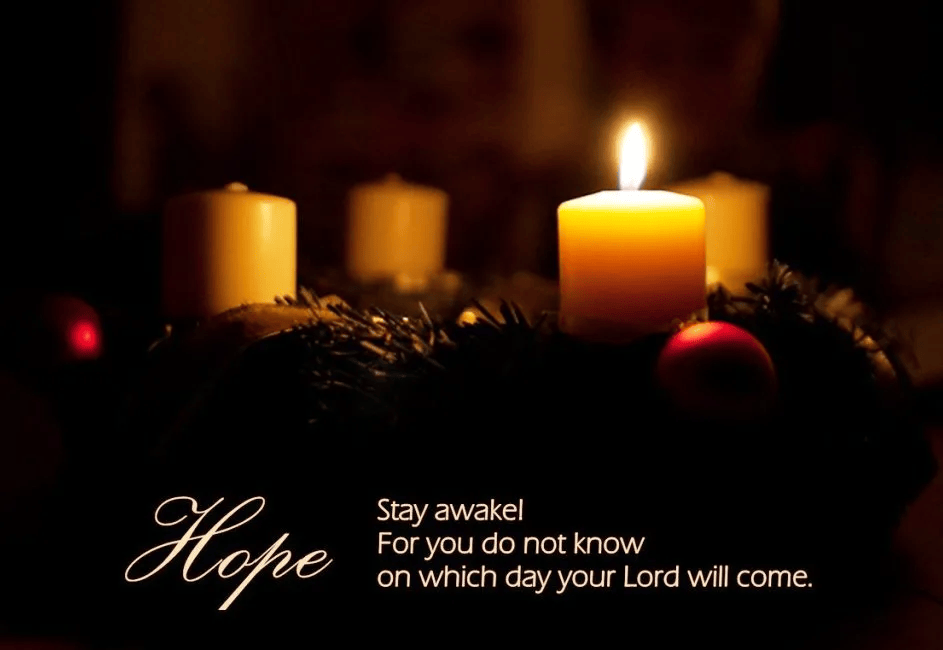
1st SUNDAY OF ADVENT
YEAR B
Mk 13:33-37
Fr. Jijo Kandamkulathy CMF
Claretian Publications, Macau
Claretian Publications, Macau
We are afraid of waiting. Not the waiting itself, but the emptiness of it. The not knowing. The hours that pass with nothing to show. And so we fill the waiting with noise. We scroll. We snack. We plan. We worry. We keep the mind busy so that it does not have to sit in the silence of the unknown. And slowly, without noticing, we stop being present to anything at all. We are there, but we are not there. Our bodies occupy the room while our attention wanders somewhere else entirely.
This is the sleep Jesus is talking about. Not the sleep of the body. The sleep of the soul. The numbness that settles over a person who has stopped expecting anything. The apathy of the one who has decided that nothing is coming, so nothing matters. And it is to this numbness that he says, over and over in this passage, four times in five verses: Stay awake.
Notice what he does not say. He does not say, be afraid. He does not say, calculate the date. He does not say, watch the signs and read the headlines. He says, stay awake. Because the danger is not that the master will come at a bad time. The danger is that we will be asleep when he comes. The danger is not the hour. The danger is us.
And notice what he gives the servants. He gives them authority. Each one has their work. The doorkeeper has the door. This is not a parable about idle waiting. It is a parable about ordinary faithfulness. The master does not tell the doorkeeper to stand at the window and stare at the horizon for years. He tells him to keep the door. To do his work. To be at his post. To be ready to open. The vigilance is not in the strain of watching. The vigilance is in the faithfulness of the ordinary. The doorkeeper who does his work each day and stays alert at his post is the one who is ready. The one who abandons his post to gaze at the road is the one who is unprepared.
This is the psychospiritual heart of the passage. We imagine that readiness is a special state, a heightened intensity, a spiritual alertness that we must manufacture by effort. And so we attempt it for a while and then collapse in exhaustion. But readiness is not intensity. Readiness is presence. It is being where you are. It is doing what is in front of you with your whole heart. The doorkeeper is ready not because he is anxious but because he is at his post.
And this is where our real struggle lies. We do not find it hard to be intense. We find it hard to be present. The ordinary is what defeats us. The dishes, the commute, the same conversation, the same prayer, the same face across the table. The daily work of the door. And in that repetition, something in us begins to drift. We begin to live elsewhere. We begin to save ourselves for the important moments and sleep through the ordinary ones. But the master does not come in the important moment. He comes like a thief. Which is to say, he comes in a moment we did not select. And the only way to be ready for an unselected moment is to be awake in all of them.
Think of the four watches. Evening, midnight, cockcrow, morning. The whole night. The long, uneventful, dark night. This is not a warning about the last days. This is a description of a life. The evening when things are still bright and we are still hopeful. The midnight when the darkness is complete and nothing can be seen. The cockcrow when we are exhausted and the dawn is close but has not yet come. The morning when we have forgotten that we were ever waiting. And the question is whether we will still be at the door in each of them.
There is a story told of a monastery where the monks took turns keeping watch through the night before the Blessed Sacrament. One young monk complained to the abbot that nothing ever happened during his hour. The abbot said, “You are not there to make something happen. You are there so that someone is there.” That is the doorkeeper’s task. Not to produce. Not to perform. To be there. To keep the door. To make sure that the house is not empty of attention.
And this is the gift of Advent. We are given a season of waiting so that we can learn how to wait. We are given a small night to practice for the long night. We are taught to be present in the small hours so that we can be present in the great ones. The one who cannot stay awake for the ordinary watch will not be awake for the coming of the Lord. Because the Lord does not come to interrupt our waiting. He comes to fulfill it. He comes to those who are waiting, and he comes as the answer to a question they have been asking with their whole lives.
How often I have been asleep. Not in the body. In the soul. How often I have been in the room and somewhere else entirely. How often I have done the work without being present to the work. How often I have said the prayer without being present to the one I was praying to. How often I have waited for a great moment while the small moments slipped past unnoticed. And I hear the voice of the master. Stay awake. Not because I am a harsh master. Because I am coming. Because what you are waiting for is real. Because the door you are keeping is the door I will knock on.
Stay awake. Not in fear. Not in calculation. Not in the strain of endless vigilance. But in the quiet faithfulness of one who is where they are, doing what they have been given, waiting with the whole heart. The master has gone on a journey. He has given each of us our work. And he will come. Not to catch us. To find us. To find us at the door, awake, with our hand on the latch, ready to open.



Leave a Reply