Twenty-second Sunday in Ordinary Time (A)
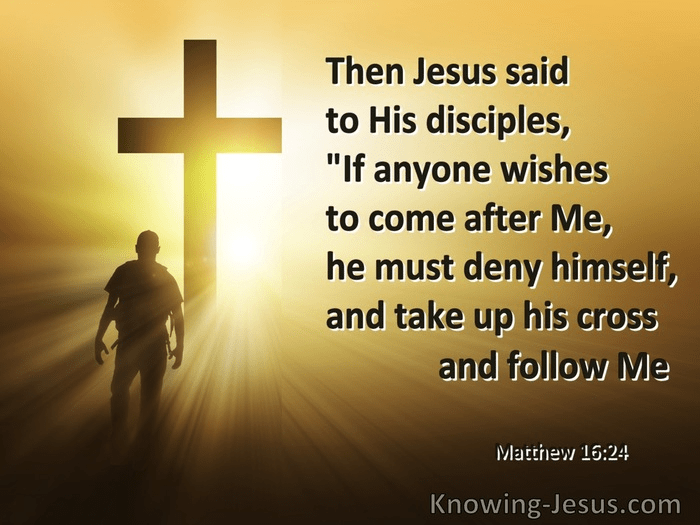
“Whoever wishes to come after me must deny himself, take up his cross, and follow me”
Fr. Vimal MSUSAI(Ranchi, Jharkhand, India)
Today, we consider that to see Jesus and follow Him means to have a mature obedience that enables us to listen and respond (response-able). And this is possible only in the person who is truly liberated from the childish cravings of the ego and passions: “Whoever wishes to come after me must deny himself, take up his cross, and follow me” (Mt 16,24). To hear and respond to God’s call in our daily lives means that we possess the ability to forget ourselves and serve others. Only love makes such a risk possible (cf. Heb 5:8-9).
The sage Buddha tells that “To live a pure unselfish life, one must count nothing as one’s own in the midst of abundance.” A concrete example is the family life where parents have fully and generously dedicated themselves for the good of the children, perhaps even to the point of forgetting themselves. They choose to do so in order that their children will be well prepared for a better future. In so doing, the family will be one and united.
We have countless inspiring models from teachers, doctors, social workers, consecrated persons and saints. Pope Francis inspires us to “see” Jesus in our daily life, because “although the life of a person is in a land full of thorns and weeds, there is always space in which the good seed can grow. You have to trust in God!”
A grain of wheat can only be lifegiving once it falls to the ground and dies (cf. John 12:24). This is also true in Jesus who in dying will show all his love by giving his life. Thus, the example of the grain of wheat is the life of Jesus and of every disciple who wishes to serve him, witness to him and have life in him: “whoever loses his life for my sake will find it” (Mt 16:25). Amen!
Thoughts on Today’s Gospel
- “He who does not deny himself cannot approach Him who is above him. But if we abandon ourselves, where will we go outside of ourselves?” (Saint Gregory the Great)
- “This is not an ornamental cross or an ideological cross, but it is the cross of life, the cross of one’s duty, the cross of making sacrifices for others with. In assuming this attitude, these crosses, we always lose something. It is losing in order to win” (Francis)
- “By his loving obedience to the Father, “unto death, even death on a cross” (Phil 2:8), Jesus fulfils the atoning mission of the suffering Servant, who will “make many righteous; and he shall bear their iniquities” (Is 53:11)” (Catechism of the Catholic Church, n. 623)

 Homily Homes
Leave a comment