Year A: 2nd Sunday of Easter
John 20:19-31
Fr. Jijo Kandamkulathy, CMF
Claretian Missionaries
Let me take you inside the mind of Thomas. Not the cartoon “doubter” we have reduced him to. Not the stubborn empiricist demanding laboratory proof. But a real man, shattered by grief, living through the most confusing eight days of his life.
The first day of the week. Mary Magdalene had come running with impossible words: “I have seen the Lord.” Thomas heard her. He wanted to believe. But grief has a way of turning hope into an accusation. If he is alive, where was he when they killed him? Where was he when I ran away?
That evening, the others gathered behind locked doors. Thomas was not there. We do not know why. Perhaps he needed air. Perhaps he could not stand their fearful whispers. Perhaps he had gone to weep alone. When he returned, their faces were different. Peter was almost laughing. John had tears—but not of sorrow. And they told him: “We have seen the Lord.”
Thomas listened. He said nothing. But inside, a storm began.
You have seen? All of you? While I was out? While I was alone in my misery, he came to you? Why not to me? Did I do something wrong? Did I desert him too quickly? Did he count my denial worse than Peter’s? Peter denied him with curses, and still Jesus showed himself to Peter. But to me? Nothing.
That night, Thomas lay awake. He replayed every moment of the past week. The arrest. The trial. The hill. The darkness at noon. The cry. The silence. He had loved Jesus with a fierce, practical love. When Jesus said, “Let us go to Lazarus, even if it means dying,” Thomas was the one who said, “Let us also go, that we may die with him.” He was no coward. He was a man who wanted to walk into death with his teacher. But when death came, Thomas ran like everyone else. And the shame of that running—it was a wound deeper than any nail mark.
Now the others claimed they had seen. They described the room. The locked doors. The sudden presence. The greeting: “Peace be with you.” The showing of hands and side. Thomas listened to every detail. His heart raced. His mind fought back.
Are they lying? No, they are not liars. Are they hallucinating? Grief does strange things. But ten people do not have the same hallucination. Unless… unless it is true.
And then came the terrible thought: If it is true, then he came to them and not to me. Why? Was I not faithful enough? Did I not love him enough? Did he forget me? Did he choose to leave me out?
This is the agony of Thomas. It is not intellectual doubt about resurrection. It is the wound of feeling excluded. He was not there. He missed the visitation. And in the silence of those eight days, that absence became a voice whispering: You are not worthy. You are not loved. The others are special. You are left behind.
Have you felt this? In prayer groups, when others speak of consolations, and you sit silent. In the Eucharist, when others weep with joy, and you feel nothing. In moments of loss, when everyone else seems to have received a sign, and your heaven is empty. That is Thomas. That is us.
His famous demand—“Unless I see the mark of the nails and put my finger into his side, I will not believe”—was not a scientific requirement. It was a cry of a wounded heart. If you are real, show me. If you love me, prove it. Because right now, I feel like the forgotten disciple. The one you passed over.
He said those words to his friends, perhaps too loudly. Perhaps with a bitter edge. They fell silent. They did not know what to say. And in that silence, Thomas regretted his outburst. Now they will think I am faithless. Now they will pity me. Or judge me. But he could not take it back. The demand stood.
Then came the eighth day. The first day of a new week. The disciples were gathered again. This time, Thomas came. He almost did not. He almost stayed home, wrapped in his blanket of hurt. But something—hope? habit? a flicker of hunger for the old community?—pulled him back. He sat in the corner, not speaking, expecting nothing.
And then Jesus was there.
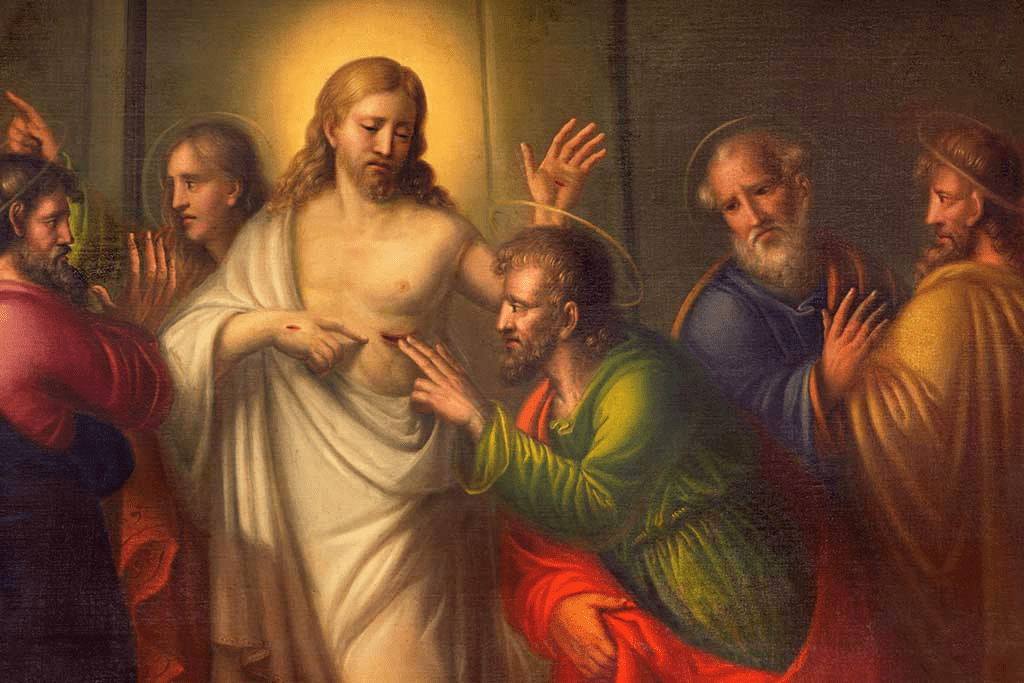
No knock. No opening of doors. Just presence. The same greeting: “Peace be with you.” And then, without accusation, without reproach, Jesus turned to Thomas. Directly. Gently. And he said the words that Thomas had hurled like a challenge: “Put your finger here and see my hands. Reach out your hand and put it into my side. Do not be unbelieving, but believe.”
Here is the moment of inner drama. Thomas had said, “Unless I touch, I will not believe.” But now, faced with the Risen Lord, he does not touch. The text does not say he touched. It says he answered, “My Lord and my God!”
Why? What happened in that split second?
Thomas realized that his demand for touch was never really about touch. It was about being seen. It was about being known. It was about the Lord acknowledging him—Thomas, the one who was absent, the one who felt left out, the one who had spoken rashly out of pain. And Jesus did not just grant his demand. Jesus quoted his demand back to him. That meant Jesus had heard him. Jesus had been listening to his angry words spoken in the locked room eight days earlier. Jesus had not forgotten him. Jesus had come back—specifically for him.
In that moment, Thomas did not need to touch. The offer of touch was enough. The offer was the proof. Because it meant that the Lord knew his name, knew his wound, knew his secret shame, and still came to him. Not with a lecture. Not with “I told you so.” But with an invitation: “Here. See. Touch. It is really me.”
Thomas’s heart broke open. Not from proof. From love. All the agony of eight days—the jealousy, the fear, the sense of abandonment, the self-loathing—drained away in a single cry. “My Lord and my God!” Not a theological formula. A gasp of recognition. You are mine. And I am yours. And I was never left out. You were waiting for me to come back to the room.
If you are the Thomas today—if you have not seen, if you feel passed over, if your prayers hit a ceiling of silence, if your wounds have turned into demands—know this: The Lord is not offended by your honest agony. He is not keeping you out. He is waiting for you to return to the locked room of the community. And when you do, he will already be there. He will call your name. He will offer you his wounds. And you will not need to touch. You will only need to fall down and say, “My Lord and my God.”

 Homily Homes
Leave a comment