Year A: 4th Sunday in Ordinary Time
Gospel:Matthew 5:1-12a
Fr. Jijo Kandamkulathy, CMF
Claretian Missionaries
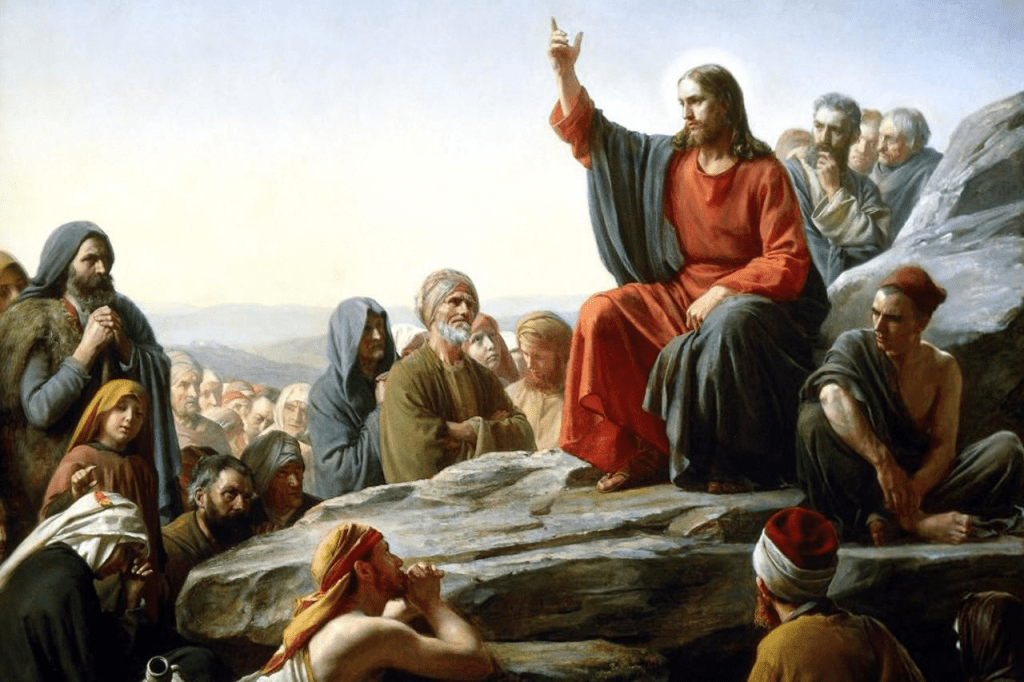
This Sunday, we are summoned to the mountainside. We are taken away from the bustling plains of conventional wisdom, from the marketplace of worldly success, and invited to sit at the feet of Jesus. Here, with a single, sweeping proclamation, He overturns the very foundations of our understanding of happiness, of blessing, of a life well-lived. The Beatitudes are not gentle suggestions; they are a revolutionary manifesto of the Kingdom of Heaven. They do not describe eight different groups of people, but rather paint a single, stunning portrait of the Christian heart—the heart of Christ Himself, offered to us.
To the world’s ears, these words sound like a list of contradictions. Blessed are the poor in spirit? The world says, “Blessed are the self-sufficient.” Blessed are those who mourn? The world says, “Blessed are those who never stop celebrating.” Blessed are the meek? The world says, “Blessed are the assertive who claim their rights.” Jesus presents us with a divine paradox, a sacred reversal. He declares God’s favor not on the basis of accomplishment or possession, but on the basis of a fundamental openness to His grace.
Let us pause and courageously ask ourselves: Do I recognize myself in any of these portraits? This is not an exercise in guilt, but in humble honesty—the very “poverty of spirit” that opens the door to blessing.
Consider “Blessed are the poor in spirit.” This is not mere material poverty, but the profound, liberating awareness that I am not God. It is the end of the project of self-salvation. It is the person who, at the end of their strength, their arguments, or their resources, can only say, “Lord, I need you.” In a culture of curated perfection and relentless self-promotion, this poverty is a psychological liberation. It is the freedom to be a beloved dependent, a child before an infinitely generous Father.
Or “Blessed are those who mourn.” This blessing pierces our culture of avoidance. We are told to numb our pain, to stay busy, to “move on.” But Jesus blesses the sacred sorrow that arises from love: mourning over personal sin, over the brokenness of the world, over the distance from God. This mourning is not despair; it is the clear-eyed recognition that all is not right, and it is the heart’s capacity to feel that ache. It is the necessary wound that makes us long for the Comforter. Psychologically, it is the antithesis of repression; it is the healthy, holy processing of loss that makes room for divine consolation.
“Blessed are the meek”? In an age of outrage, of shouted opinions and trampling wills, meekness is seen as weakness. But the meekness Jesus blesses is not passivity. It is strength under perfect control. It is the power of the wild horse, submitted to the rider’s hand. It is the freedom from the tyranny of my own ego, my own need to be right, to be first, to be vindicated. The meek person possesses their soul in patience. Psychologically, this is resilience—the ability to endure insult without a collapse of self-worth, because our identity is anchored not in others’ opinions, but in the Father’s love. “They shall inherit the earth,” not by conquest, but by receiving it as a gift.
Finally, “Blessed are the pure in heart.” Our hearts are so often divided, compartmentalized. We give God a slice on Sunday, while other slices are dedicated to ambition, to secret vice, to anxiety, to image. The pure in heart are the integrated, the single-minded. Their inner life is not a house divided. Their “yes” is yes, and their “no” is no. This purity is a psychological clarity, an undivided loyalty to God that simplifies our chaotic interior world and allows us to “see God”—to perceive His presence and action in the ordinary moments of life, because the lens of our heart is clean.
Let us not hear the Beatitudes as a distant ideal, but as a gentle, urgent invitation to self-examination. In which of these blessings do I feel a strange resonance, a pang of recognition? That very pang may be the Holy Spirit pointing to your path to holiness. Where do I feel the most resistance, the most disbelief? That may be the very wall Christ wishes to tear down to let in the Kingdom.
This week, choose one Beatitude. Carry it with you. Ask for the grace to live it. For in doing so, you are not just following a rule. You are claiming your citizenship. You are stepping into the line of those who are blessed, and you are declaring where you truly belong.
 Homily Homes
Leave a comment