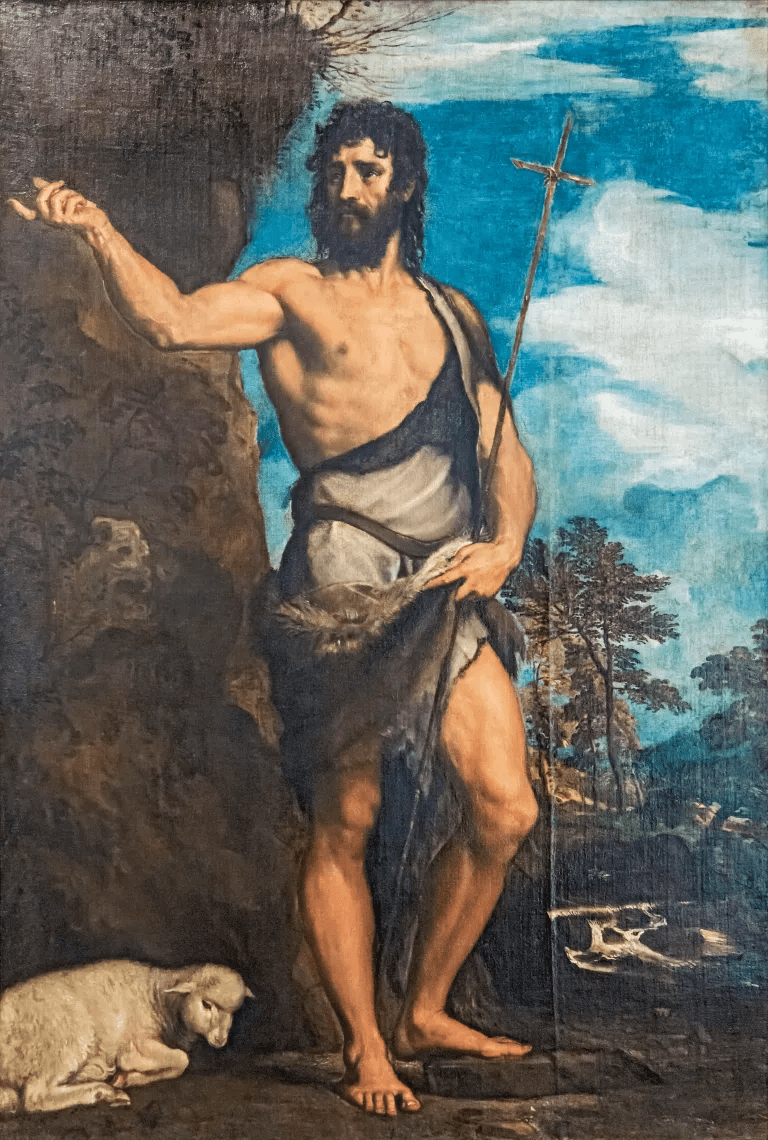
Third Sunday of ADVENT – A
Introduction
“There was a man sent from God, whose name was John“ (Jn 1:6). He was destined to prepare Israel for the coming of the Messiah. He proclaimed, “Repent, for the kingdom of heaven is at hand“ (Mt 3:2). His message is clear; the language is harsh; the proposal isdemanding. Austere and blameless, he conveyed the impression of being a master of life. He is confident in himself and his certainties, and he is firm. However, like everyone else, he was tormented by confusion, anxiety, and inner turmoil.
Jesus developed a deep respect for him and understood him well. He asked him to reflect on his theological and religious beliefs one day. He clarified that he needed to achieve the transformation he urged others to pursue. Last Sunday’s liturgy conveyed the message of John the Baptist, while today, it offers us his example.
John did not teach solely through words; he demonstrated with his life how we must always be ready to question our own security when confronted with God’s novelty. Like him, anyone passionately pursuing truth should be prepared to encounter it.
• To internalize the message, we repeat:
“The Lord does not come to condemn, but to heal.“
First Reading: Isaiah 35:1-6a,10
Predictions about the planet are bleak; for some, they are catastrophic. The world’s social, political, and economic realities are tense. We do not know how these issues can be resolved. The crisis of faith, loss of values, and weakening of many certainties portend difficult yearsahead. This, in a nutshell, summarizes popular opinions regarding the future of our planet.
We listen to the First Reading, presenting words filled with joy and hope. We assume that the prophet spoke at a time different from ours. That is not the case. He lived during one of the most challenging periods in his people‘s history. Jerusalem and its magnificent temple were destroyed. The most capable and prepared individuals were deported to Babylon. The holy city lay in ruins. Only the old, the sick, and the children remained. Silence and death reigned over all. No songs, no cries of joy, only sadness and many tears!
The hill on which the town was built, now ruined and devastated, has been reduced to a desert where no grass grows. In the face of such desolation, who would have the courage to throw a party, invite to jubilation, or rejoice? Right in front of these ruins, the prophet announces his oracle, full of optimism. He is a sensitive man; he has the soul of a poet and expresses himself in delightful imagery.
He says the desert will become as fertile as the plains of Sharon along the coast of the Mediterranean. It is adorned with leafy trees, strong like the cedars of Lebanon; it transformsinto a carpet of aromatic herbs and flowers in an eternal spring. Opium flowers and lilies bloom, representing joy and the dreams of lovers. Everywhere, songs of joy and rejoicing are heard (vv. 1-2).
Wonder? No! It contemplates the beautiful work that God is destined to accomplish. If we trust the Lord, discouragement, slumped shoulders, and trembling knees carry no weight. Who gives up in the face of evil? Anyone who sees it as inevitable demonstrates disbelief in the love and fidelity of God, who is actively involved in the history of His people. Those who believe are never devastated but are convinced that a garden will flourish one day where there is currently only an arid and barren desert (vv. 3-4).
In the second part of the reading (vv. 5-6), the prophet presents the miraculous transformation of a divinely wrought world. To describe it, he employs the imagery of recovery from illnesses: the eyes of the blind will open; the deaf will hear; the lame will leap like a calf; the tongue of the mute will shout for joy. Each disease, whether physical, mental, or spiritual, represents a form of death. Where the God of life arrives, every evil and every death disappears. In today’s Gospel, Jesus invites the Baptists to observe the transformation. The power of his words is causing ‘flowers to blossom in the desert.’
The last part of the reading (vv. 8-10) describes the path to the new reality by introducing a splendid image: the pilgrimage of the people from the land of slavery to Mount Zion to the unforgettable Jerusalem, the city of joy and freedom. It symbolizes the journey of allhumanity toward life. The road ahead will be called the “holy way“ because it will not be trodden by impure feet. As we understand it today, this is how Jesus traveled, leading to the gift of life.
The image becomes elaborate. The prophet sees the characters who participate in this procession: at the front, perennial happiness guides, followed by joy and cheerfulness. Two dark shapes are visible on the horizon—sadness and tears. Defeated, they distance themselves from each other in escape. These are the words of God denouncing the prophets of doom.
Despite contrary signs, the believer understands that the Lord “enlightens those who sit in darkness and the shadow of death and guides their steps in the ways of peace“ (Lk 1:79).
Second Reading: James 5:7-10
Jesus denounced the dangers of wealth, calling those who hoard worldly goods fools. However, he never hurled invectives against anyone because of their riches. Here, we find what James says to the wealthy: “…You deceived the workers who harvested your fields, but now their wages cry out to the heavens. The reapers’ complaints have reached the ears of the Lord of hosts. You lived in luxury and pleasure in this world, thus fattening yourselves for the days of slaughter. You have easily condemned and killed the innocent since they offered no resistance“ (Jas 5:1-6).
After addressing the wealthy, James turns his attention to the poor. This forms the core oftoday’s reading. What does he recommend to them? What counsel does he offer to the exploited? Revolt? Revenge? No, patience. This word appears four times: “Be patient“ (vv. 7-8), “do not complain“ (v. 9), and “bear“ (v. 10). These phrases may seem irritating, abrupt,and provocative. James does not condone injustice against the poor. However, he understands there are circumstances where it is necessary to wait patiently after doing everything possible.
To explain his thoughts, he uses an example from the life of a farmer. What does a farmer do? He does not sit down and look at the field, hoping to produce a harvest on its own. He is fully committed to his work: hoeing, sowing, irrigating, and weeding, yet he also knows how to wait. He understands the irresistible force of the seed and trusts the land that has never betrayed him. He believes the Lord will do His part and send the rain that benefits and enriches the ground in both fall and spring. The farmer is not discouraged, even if months pass before the mature grain appears.
James concludes by advising the poor: in your suffering, do everything you can to seekjustice, but refrain from committing violence against those who oppress you and avoidcomplaining to those close to you (v. 9).
Often, the poor, humiliated by their masters, react by becoming aggressive and hardened against their ‘neighbors’: wives, husbands, children, or any weaker individuals surroundingthem. The poor nurture the hope that the Lord will intervene to change their circumstances. His ‘coming’ is near.
Gospel: Matthew 11:2-11
Recognizing God’s Messiah is not easy. Educated by the prophets, Israel has been waiting for centuries. When he arrived, even those more spiritually prepared and well-disposed struggled to recognize and welcome him. The Baptist also remained indecisive. However, a Messiah who does not surprise or evoke wonder and disbelief cannot be from God. That would align too much with our logic and expectations. God thinks differently than we do.
In the first part of today’s Gospel (vv. 2-6), a doubt arose in the mind of the precursor, andthe answer given by Jesus is presented. John is in prison, with the reason narrated in Matthew 14:1-12. He denounced the immoral behavior of Herod, who took his brother’s wife. Josephus Flavius stated that John was confined in the Machaerian fortress. He was treated with respect and could receive visits from his disciples. He was eager to witness the coming of the Kingdom of God. He kept himself informed about how Jesus of Nazareth, whom he identifiedas the Messiah, behaved.
However, his faith begins to waver. Some say that the doubts do not belong to John but to his disciples. This is not accurate. From the Gospel, it is clear that he questioned whetherJesus was the Messiah. For this reason, he sent his disciples to ask Jesus: “Are you the one who is to come, or should we expect someone else?“ (v. 3).
How did these perplexities arise within him? The answer is quite simple. It suffices to remember the image of a messiah that John had learned about from the spiritual leaders of his people since the beginning. He is in prison and is aware of what the prophets have foretold. He has been expecting the ‘liberator’ (Is 61:1), the one responsible for restoring justice and truth to the world. He does not understand why Jesus chose not to intervene on his behalf.
John awaits a strict judge, a messiah who rails against the wicked. Yet, here, we find a surprise instead. Jesus not only refrains from condemning sinners but also eats with them and takes pride in being their friend (Lk 7:34). He recommends not extinguishing the dimly burning wick but caring for the ‘bruised reed.’ He does not destroy anything; instead, herecovers and repairs what is ruined. He does not scorn sinners but transforms their hearts and desires their happiness at all costs. He offers words of salvation to those who have lost all hope and to those shunned by everyone, like the lepers. He remains undeterred in the face of human problems. He does not give up, even in death.
To the messengers of John the Baptist, Jesus is presented as the Messiah, with signs drawn from the texts of Isaiah (Is 35:5-6; 26:19; 61:1), the prophet of hope, who had predicted, “On that day no one would complain: I am sickly“ (Is 33:24).
The Baptist is invited to observe six new realities: the healing of the blind, the deaf, the lepers, the disabled, the resurrection of the dead, and the proclamation of the Gospel to the poor. All of these are signs of salvation, not condemnation.
The new world has arrived: those who walked in darkness and had lost their way in lifeare now enlightened by the Gospel. Those who were disabled and could not take even a step toward the Lord or their brothers and sisters can now walk briskly. Those who were deaf to the Word of God now listen and allow themselves to be guided by it. Those who wereashamed of themselves, burdened by the leprosy of sin that kept them away from God and their brothers and sisters, now feel cleansed. Those who engaged only in the life-drainingwork of self-righteousness now live life to the fullest. Those who saw themselves as miserable and hopeless have begun to hear the good news: ‘There is salvation for you as well.’
The Messiah of God has nothing to do with the energetic and severe character that John expected. His way of acting scandalized the precursor and continues to shock us even today. Some still ask the Lord to intervene and punish the wicked. There are still others whointerpret misfortune as God’s punishment for those who have done evil. But can God be angry or pleasure seeing His children (even if they misbehave) suffer?
In the Gospel of Matthew, Jesus concludes his answer with a beatitude, the tenth: “Blessed is he who takes no offense at me.“ This is a gentle invitation for the Baptist to reassess his theological beliefs. A good God challenges all of John’s convictions. Like us, the Baptistsenvisioned a mighty God. When he found himself weak, he anticipated miraculousinterventions. However, events unfolded as if the Messiah had not yet arrived.
Blessed are those who accept God as He is, not as they wish Him to be! Faith in the God who reveals Himself through Jesus cannot exist without doubt, uncertainty, and the struggle to believe. The Baptist signifies a true believer. He grapples with many perplexities and asks questions, yet does not deny the Messiah simply because He does not align with his expectations. He questions his own beliefs.
He is not worried about those who have trouble believing, feel lost in front of the mystery and puzzle of existence, or claim not to understand the thoughts and actions of God. He is concerned about those who conflate their own beliefs with the truth of God, those who alwayshave ready answers to every question, those who consistently have some dogma to impose,and those who never allow themselves to be questioned: such a faith can at times border on fanaticism.
When John’s disciples left, Jesus judged him with three rhetorical questions. This is the second part of today’s Gospel (vv. 7-11). The answers to the first two questions are apparent: the Baptist is not like the reeds that grow along the Jordan, symbols of volatility because they bend according to the direction of the wind. John is not an opportunist who adapts to all situations and bows before the powers. On the contrary, he firmly opposes the same political leaders, challenging the king directly and not afraid to express his thoughts. John is not corrupt; he thinks only of his interests, accumulates money unscrupulously, and squanders it on entertainment and fine clothes. The corrupt—Jesus says—are the kings and their courtiers, the rich, and the leaders who imprisoned him.
The third question requires a positive response: John is a prophet and more than just a prophet. No one in the Old Testament undertook a mission beyond his. More than Moses, he is an ‘angel’ sent to precede the liberating coming of the Lord. The final addition is significant: “The smallest in the kingdom of heaven is greater than he“ (v. 11).
Jesus did not create a hierarchy of personal holiness and perfection; instead, heemphasized the disciples’ higher status. Those who belong to the kingdom of heaven can see far beyond what John the Baptist could. Anyone who perceives the new face of God, who understands that the Messiah has come to forgive, welcome, and love them, has embraced anew perspective– the perspective of God.
What we can see and understand today, regardless of our holiness, is what the Baptist had only guessed because he remained at the threshold of the new era.
READ: The inquiry by John seems to contradict what occurred at Jesus’ baptism by John. Here, Matthew presents Jesus as the true Messiah, the anointed one of God. In response to the disciples of John the Baptist who inquire about the Messiah, Jesus highlights the redemptive joy that arises in the hearts of the blind, the lame, the deaf, the lepers, the poor, and the dead who have returned to life. Like the sower, Paul invites us to wait with joyful patience for the fruits of his labor.
REFLECT: What kind of messiah did the people of Israel expect? Did Jesus meet that expectation? When the Lord comes, there will be an eruption of joy among all the people, especially within the marginalized groups of the world. Do I experience the joy that wells up in those who are attentive, prepared, and eagerly await the Lord?
PRAY: Pray for insight into a spiritual messiah who will not resolve all your problems or the world’s issues but will be there as you and others work through them. Pray for the gift of joy in the Spirit.
 Homily Homes
Leave a comment