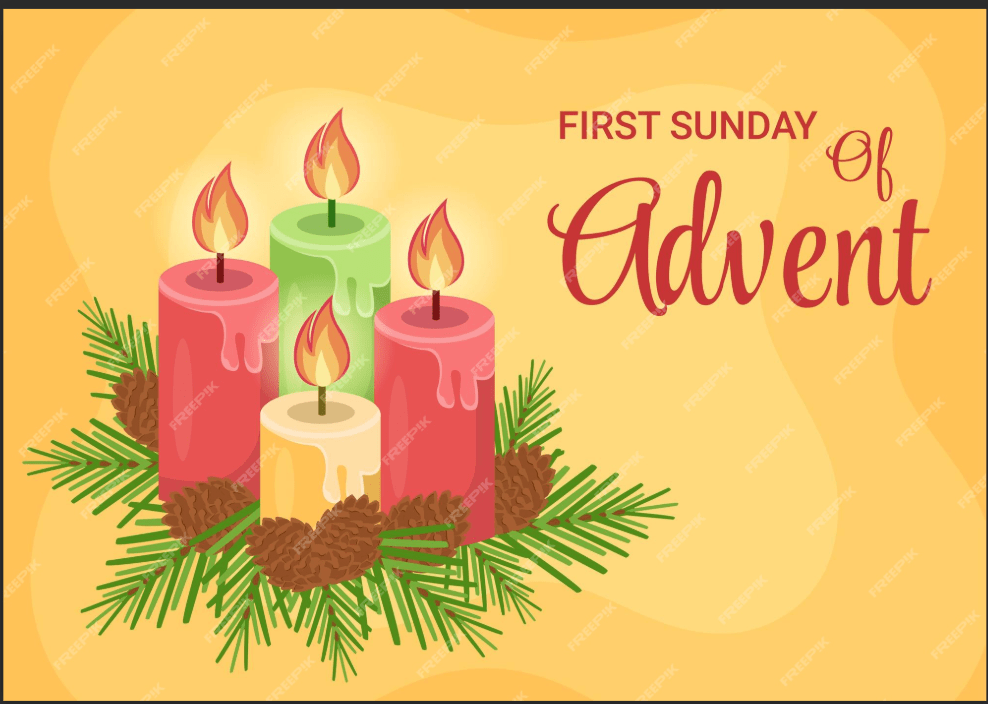
FIRST SUNDAY OF ADVENT – Year A
Introduction
“Fear the judgment of God!” Some preachers still use threats to dissuade us from evil, but this tactic is becoming increasingly ineffective. The image of God as a judge is present throughout the Gospel, particularly in Matthew, where it appears on nearly every page. So, what’s the point? The showdown is too distant and uncertain to impact our choices today. More importantly, this final forensic judgment proclaimed by God at the end of life will no longer benefit anyone. At that moment, it will be impossible for anyone to make up for lost or misused time.
We are interested in another judgment of God: the one He expresses in the present. Faced with the choices we are all called to make, we hear many judgments: those of friends, advertising, fashion, vanity, jealousy, pride, and relativistic modern moralities, among others. There is also the judgment of God—in fact, the only one that shows the way of life and the only one that will prove valid in the end—but this is often too faint, muted, and overwhelmed by other judgments.
To keep watch means being able to recognize and understand judgment that arrives in unexpected ways and at unexpected times.
• To internalize the message, we repeat:
“Make me follow, O Lord, your judgments.”
First Reading: Isaiah 2:1-5
At least once a year, the Israelites journeyed to the temple in Jerusalem to partake in feasts and offer sacrifices to fulfill their vows. Isaiah—the prophet born and raised in the aristocratic and cultured atmosphere of the capital—observed daily groups of pilgrims climbing the mountain of the Lord “amidst shouts of joy and thanksgiving, among the feasting throng” (Ps 42:5). It is a moving spectacle that stirred his sensitive soul, giving rise to dreams, expectations, and hopes that he expresses magnificently in his poem, today’s First Reading.
Times are tough, and the situation is dire for the small kingdom of Judah, which is under attack from a coalition of people eager to embark on a reckless war against the Assyrians. The enemy army is advancing, and the hearts of King Ahaz and his people tremble like trees in aforest buffeted by the wind (Is 7:2).
Everyone is stunned; only Isaiah remains calm and calls for trust in God. Jerusalem will not be conquered, he assures, then, enraptured as in ecstasy and with his eyes fixed on the distant future, he delivers his oracle. ” Here, ” he says, ” I see the mountain of the house of the Lord rise; it becomes the highest point of the earth. I see a vast crowd of pilgrims from every person, tribe, language, and nation (v. 2) going to the sanctuary. They do not go to offer sacrifices, burnt offerings, and incense but to hear the word of the Lord. They want to learn his ways” (v. 3).
The result of this approach to the mountain of the house of the Lord is peace, vividly depicted in striking images (v. 4). The instruments of death—swords, and spears—are transformed into means of production, becoming plowshares and pruning hooks. The people dismantle their weapons and put an end to wars. This represents the hope of universal disarmament. It embodies the kingdom of justice and God’s blessings.
Similar messages—at least in appearance—have already been proclaimed. Countless inscriptions on stelae and in literary texts celebrate the glorious deeds of the pharaohs and the rulers of the ancient Middle East, all announcing peace. The enthronement of the new king was always hailed as the beginning of a golden era. In almost messianic language, a song of Ramses IV proclaims: ‘Those who hunger have been satisfied and are happy; those who were naked are clothed in fine linen; those who were in prison were set free; those who were fighting in this country were reconciled.’
Yet, when he proclaimed himself a peacemaker in the world, the pharaoh ceremonially shot an arrow toward each of the four cardinal points. This gesture aimed to instill fear inanyone planning to attack his country. He promised peace but continued to believe it couldonly be achieved through the threat of force and the display of military power.
Isaiah proclaims a new kind of peace, not founded on trickery or human schemes, but on the unity of all peoples—gathered in the city of peace—around the word of the Lord. This word transforms hearts. Those who embrace it stop building Babel and permanently rejectaggression and the use of weapons.
Christians saw this prophecy fulfilled when peace entered the world through Jesus. He is our peace; He came to preach peace to those far off and those near (Eph 2:14-17). Since the early centuries, the Jews have disputed this interpretation. They argue that Jesus of Nazareth cannot be the Messiah, the peacemaker announced by the prophet, because the new world hasnot yet come. Perhaps! This objection is valid, but it arises from a misunderstanding. The Kingdom of God, or universal peace, is not established miraculously without people’scooperation. It develops gradually, like a tiny seed that takes years to grow into a large tree.
The last days mentioned by the prophet (v. 2) have already begun; their promises began to be fulfilled with Christmas. The early Church Fathers were well aware of this. ‘The otherscontinue to appeal to the sword, but we are a people who refuse to learn the art of war: through Jesus, we have become the children of peace” (Origen, Against Celsus v. 33).
Justin replied to Rabbi Trypho: ‘Although we are well experienced in war, murder, and all kinds of evil, we have transformed our instruments of war across the earth: swords into plowshares and spears into pruning hooks. Now we build the fear of God, justice, humanity, faith, and hope– the hope from the Father’ (Justin, Dialogue with Trypho, 110, 2-3). Irenaeus was even more explicit: ‘We no longer wish to fight, but if someone strikes us, we turn the other cheek. If all this happens, then the prophets have spoken of no one other than the one who created all these things: Jesus of Nazareth, our Lord (Irenaeus, Adv. Haer, IV, 34, 4).
The world of peace will indeed be established, but its construction will proceed more rapidly when humanity’s choice to turn to Christ becomes more decisive.
Second Reading: Romans 13:11-14
To describe the life of Christians, Paul draws on biblical images of light and darkness. He states that before baptism, they walked in the darkness of the night and committed acts that we are ashamed to do in the light of day: drunkenness, revelry, immorality, and strife. These actions cloud the mind, harden the heart, and prevent us from grasping God’s judgments about the reality of this world. After baptism, they abandoned these behaviors and entered the realm of light; they were stripped of their old selves and put on something new: Christ. Within them, it is now possible to contemplate the work, the gaze, the words, and the smile of the Master as they are wrapped like a mantle in the person of Jesus.
Paul, however, observes that darkness, even among Christians, is not yet over; he recognizes that a somber night still weighs upon the world. Wars, revenge, and envy persist, but he does not allow despair to consume him, as often happens to us. His words serve as an invitation to hope: the night is already late; it is about to end. A new day is set to dawn, and a new humanity is on the verge of beginning. What confidence Paul displays even after 30 years of Christianity!
Today, problems are dramatic and widespread. We are warned that the world is heading toward ecological and demographic disaster and a loss of values. While this is true, seeing darkness and approaching the future pessimistically is unwise, especially after 2,000 years of Christianity. Qohelet already cautioned: “ One who says that the former days were better than the present is not wise “ (Ecl 7:10).
If we shared the apostle’s perspective and believed, like him, in the presence of the Spirit, we would notice, even in the darkest moments, the bright signs of the new world that hasbegun.
Gospel: Matthew 24:37-44
The language in this Gospel passage can lead to extravagant interpretations, or even rants,about the end of the world and God’s punishment. It can also be seen as an invitation always to be ready because death can come suddenly and catch us unprepared. These interpretations arise from a lack of understanding of the apocalyptic literary genre widely used at the time of Jesus, though it alienates our mentality and culture.
One principle we should always remember is that the Gospel is, by its nature, good news—a message of joy and hope. We can be certain that anyone who uses it to instill fear and create anxiety is misusing it in a way that strays far from the true meaning of the text.
In today’s passage, the tones are ominous: cataclysm, destruction, and the danger of death. The language is deliberately harsh and biting; the images reflect punitive judgment because Jesus aims to warn against the significant risk of missing the chance for salvation that the Lord offers. Negligence, ignorance, lack of attention to the signs of the times, and spiritual insensitivity lead to catastrophe. Anyone who loses sight of the realities of this world and becomes absorbed in business lives in slumber and is dulled by the pursuit of pleasure faces a dramatic awakening.
But what are these images? We recall the context in which the passage is set. One day, the disciples invite the Master to admire the magnificent building of the temple. Instead of sharing their justifiable pride, Jesus surprises them with a prophecy: “You see all these things? I assure you, not a stone will be left upon another here. All will be torn down” (Mt 24:2). A Jerusalem that refuses to be converted is decreeing its downfall. Amazed, the disciples ask him two questions: when will this happen, and what are the warning signs? (Mt 24:3). Instead of satisfying their curiosity, Jesus responds by introducing teachings that arevalid for people of all times: it is necessary to remain vigilant. To clarify further, he cites three examples:
The first is taken from a story in the Old Testament (Gen 6−9). In Noah’s days, there were two categories of people: some thought only of eating, drinking, and being merry. They were unprepared and perished. Others were vigilant, attentive to what might happen. They realized that the flood was approaching; they were saved and began a new humanity (vv. 37-39).
Just as the flood came suddenly—Jesus says—the destruction of Jerusalem will also come without warning. In the days of Noah, many perished; similarly, the Jews who refuse torecognize him as God’s messenger and disregard his words will face disaster in the city. Those who open their eyes and hearts to accept his message will be saved and will give rise to a new generation.
The second is inspired by men’s and women’s daily activities, such as working in the fields and preparing flour to make bread (vv. 40-41). Just as they live in more ordinary and mundane circumstances, some are attentive and behave like individuals, recognizing the coming of the Lord. Others are distracted, careless, and negligent, laying the groundwork fortheir ruin. Their actions appear identical: they work, earn a living, eat, drink, and marry. However, the way they approach these tasks is radically different. Some are careful, guided by God’s light, and are taken or saved. Others are overwhelmed by worldly cares, failing toconsider the judgments of God. They ‘are left,’ indicating that they are not engaged in the new reality of God’s Kingdom.
The decision to be made is urgent and dramatic; it comes down to choosing between life and death, which is why Jesus insists: “Keep watch because you do not know on what day your Lord will come” (v. 42). It is worth repeating: Jesus is not coming to have a showdown at the end of our lives. He comes today with his saving judgment.
The third example is even more explicit: the thief will not warn you before he arrives, sothe owner cannot doze off, even for a moment. He must stay awake. Otherwise, he risks having all his possessions stolen (v. 43).
This God is truly unique! He behaves like a thief and seems eager to seize the moment when someone is unprepared. The picture may not be the best, as it conveys a sense of threatrather than salvation. However, it is effective; it serves as a wake-up call, drawing attention to the impending danger of failing to recognize the favorable moments of the day when the Lord invites us into His peace.
Even the inhabitants of Jerusalem—Jesus meant—would have to remain vigilant to avoid being surprised by the tragedy that would later strike them. On another occasion, Jesus expressed his heartfelt appeal: “Jerusalem, Jerusalem, you who kill the prophets and stone those who are sent to you. How often would I have gathered your children together, as a hen gathers her chicks under her wings, but you refused?” (Mt 23:37).
The conclusion addresses the theme of the passage. It applies to the disciples of every age: “So be alert, for the Son of Man will come at the hour you least expect” (v. 44). We understand what it means to miss favorable opportunities; so many times, we have had thatexperience. The more surprising and unexpected they are, the more they deviate from our usual judgment criteria, making it easier for us to let them pass by.
The arrival of God in our lives is always challenging to comprehend because it does not align with human wisdom; it is incompatible. It contrasts with our prevailing mentality. Only vigilant people can recognize it and find salvation here and now.
Jesus teaches us to remain vigilant and be ready, for the day of the Son of Man will arrive at the least expected hour.
REFLECT: We prepare for two types of coming—the final coming of the Cosmic Christ and the personal coming of Christ into our hearts. The best preparation is to be taught by Him. He has already been teaching us through Scripture. How open am I to be guided by God? Am I sufficiently prepared for the coming of Christ through my familiarity with and obedience to the Word of God?
PRAY: In your prayer, reflect on your actions, and in God’s presence, take responsibility, even if you find it challenging to do so. Listen to Him attentively.
ACT: Prepare for the future by living in the present with faith. Create an action plan for Christmas, identifying specific tasks to enhance your faith. Appreciate your talents and use them to the best of your ability.
 Homily Homes
Leave a comment