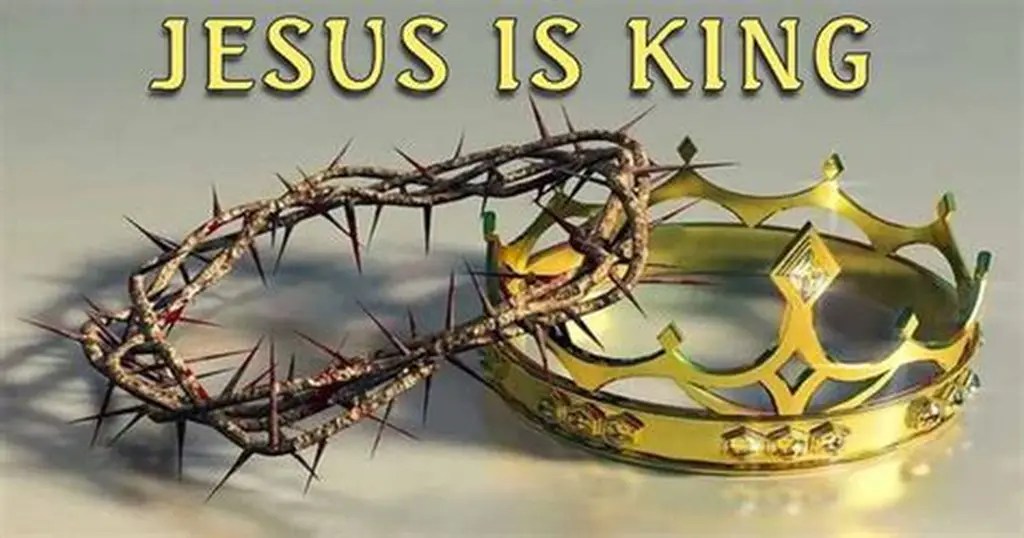
Today, the last Sunday of the Church year, we celebrate the Feast of Christ the King. It is one of the most beautiful and meaningful feasts of the year.
The concept of king and kingdom is at the very heart of Jesus’ message to us. He came to inaugurate among us the Kingdom of God. By this we understand that complex of people and communities which have totally accepted and assimilated the vision of life under God which Jesus proclaimed. It is a vision, not only for a minority sect among the peoples of the world, but a call that is valid for all, a message which contains the deepest hopes and longings of peoples everywhere.
To take on board this message is to enter a life of fullness, of deep happiness and satisfaction. It is not necessarily a life without pain or suffering. In fact, pain and suffering may be integral to the very development of the Kingdom vision in our lives. It is a life which essentially involves other people, who on the one hand are agents of my personal growth, and who on the other, depend on me to be the agents of their growth.
Behind all this is the figure of Jesus Christ, our King. In himself, he embodies the whole vision of the Kingdom by the way he lived, spoke, worked, taught, healed, liberated, and finally sacrificed his life in love for us.
In today’s Scripture readings, we are given two extraordinarily contrasting images of our King. They are complementary and we cannot have one without the other.
In the reading from the Letter to the Colossians we have a description of the Son as emanating from the Father with all the power and dignity of God. The letter tells us that we have been:
…transferred…into the kingdom of his beloved Son, in whom we have redemption, the forgiveness of sins.
We gain our freedom through his “forgiveness of our sins.”
To enter the Kingdom is to experience being brought from darkness into light and we gain our freedom through the forgiveness of our sins. To be free and to be in sin are mutually exclusive.
Who is this Son? Paul says:
He is the image of the invisible God, the firstborn of all creation, for in him all things in heaven and on earth were created, things visible and invisible, whether thrones or dominions or rulers or powers—all things have been created through him and for him.
And Paul says:
He himself is before all things, and in him all things hold together.
In other words, before anything was created, the Son existed.
This is the special gift that the Son is for us. Through his taking on himself our human nature, we have been given access to the very being of God himself. We have access to the way God thinks, the way God loves. Being made in his image, we are called also to reflect in our lives the way God thinks and loves. And so the Son is called Pontifex (Latin, ‘bridge-builder’) and ‘Mediator’—for in his humanity as Jesus, he is the visible link between God and ourselves.
In the man Jesus, we have an intimate access to God, and yet God remains transcendent and, in many respects, unknowable and unattainable. In Jesus we see God as—to use Paul’s phrase:
…only a reflection, as in a mirror… (1 Cor 13:12)
When Jesus speaks and acts, it is both a man and God who speaks and acts, but the fullness of God cannot be accessed through the human body of Jesus. So it is that all the prayers of the Church go through Jesus to the Father. Jesus is the Way; the Father is the End, the Ultimate Goal.
But the letter goes further, for it says that:
He is the head of the body, the church; he is the beginning, the firstborn from the dead, so that he might come to have first place in everything.
The body of the risen and glorified Jesus is not now a human body, but the whole Christian community taken together. It is now our calling and responsibility to be the mediating agent between God and the world. It is for us to proclaim the Kingdom both in word and in the way we live together, because:
By this everyone will know that you are my disciples, if you have love for one another. (John 13:35)
Together with Jesus as the Head of our Body, we have a special mission to be pontifex and mediator between God and the world.
In the Gospel, we are transported to an altogether different scene, a scene that can scarcely be reconciled with the image of the Second Reading. Jesus, our King, is hanging nailed to a cross between two other executed criminals. On the sign above his head are the words:
This is the King of the Jews.
On each side are his two ‘courtiers’, a pair of murderous gangsters. Apart from the terrible physical pain he experiences, Jesus has been stripped of all dignity as he hangs there naked before a mocking world. This is the final ‘emptying’ (Greek, kenosis) described in the Letter to the Philippians (2:7). Is this truly, as described in the Second Reading:
…the image of the invisible God, the firstborn of all creation…
Is this the same One through whom “thrones or dominions or rulers or powers” were brought into being? No wonder that Paul says the Cross of Jesus is a scandal:
…a stumbling block to Jews and foolishness to gentiles… (1:Cor 1:23)
For our part, can we see and understand that this moment of utter degradation is in truth the most glorious moment in the life of Jesus? The moment when he gave the:
…uttermost proof of his love…
(John 13:1, Knox Bible translation)
Below the cross, the religious leaders, who engineered his execution, now mock the Teacher and Wonderworker who drew huge crowds, saying:
He saved others; let him save himself if he is the Messiah of God, his chosen one!
The soldiers, too, only knowing by hearsay that he claims to be a ‘king’, join in the jeering, as does one of the criminals beside him, who says:
Are you not the Messiah? Save yourself and us!
But it is the other criminal who shows deeper insight. He fully acknowledges his own guilt, but sees that Jesus is totally innocent of any wrongdoing. And he turns to Jesus, addressing him with a strange intimacy:
Jesus, remember me when you come into your kingdom.
It is an acknowledgement of Jesus’ Kingship. Once again, Jesus sees not the stereotype nor even the vicious past of this man, but only the repentant individual before him here and now. That is enough, and he says:
Truly I tell you, today you will be with me in paradise.
What an extraordinary thing to say! There is no delay, no testing of the genuineness of the man’s repentance. Today with Jesus, he enters into eternal glory, into the very fullness of the Kingdom—even before any of Jesus’ other disciples, before his own Mother!
Here is the wonder of our King and what it means to be part of his Kingdom. It is beautifully described in the Preface to the Eucharistic Prayer in today’s Mass:
As King he claims dominion over all creation,
that he may present to you, his almighty Father,
an eternal and universal kingdom;
a kingdom of truth and life,
a kingdom of holiness and grace,
a kingdom of justice, love and peace.
Our King has been chosen for us by God, but it is for each one of us to profess our allegiance to him. We do this, not just by saying it in so many words, but by taking on board the fullness of his life and teaching which we find in the Gospels and in the rest of the New Testament. And as members of his Body, we too—in some strange way—share in that Kingship. Today we are called to work together to expand the reality of his Kingdom in our families, in our society and in the world generally.
Lord Jesus, your Kingdom come!
 Homily Homes
Leave a comment